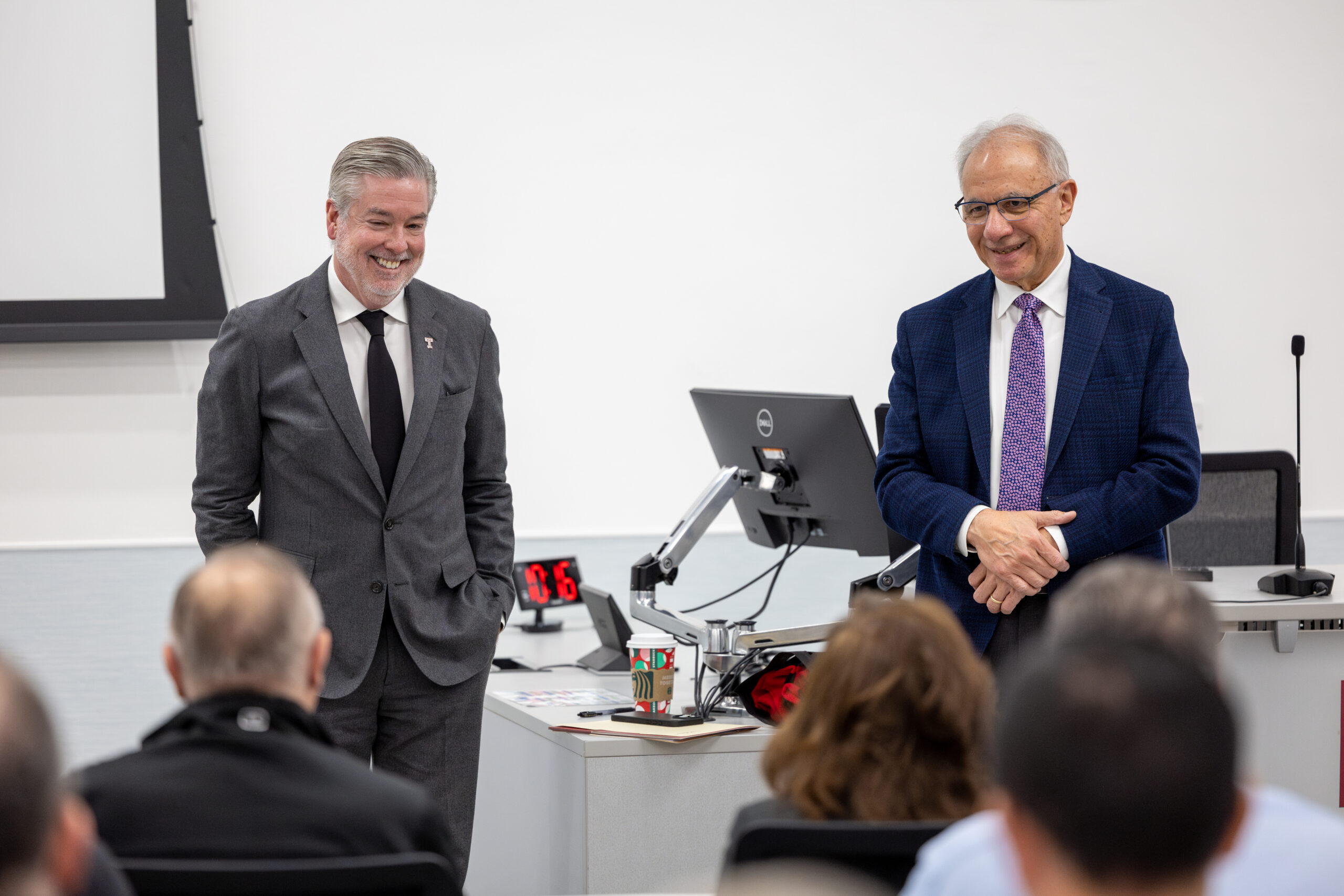
President John Fry, MBA, left, with Dean Ismail in Timmons Hall with management committee
I’VE SPENT MORE THAN three decades in higher education leadership, but my involvement really began when I was a student myself. From those early experiences, it has been clear to me that higher education is always evolving and always being challenged to adapt. It is a dynamic sector, and I don’t expect that to change in the next decade.
What I do expect is that higher education will need to continue earning and rebuilding the public’s trust. That certainly includes providing a world-class education to our students and producing graduates who leave Temple ready to make an impact in their communities. Because the more people who see Temple students and alumni making an impact in the real world, the more they will believe in us and our mission.
But there are other ways that we can make our impact and importance known. I believe higher education institutions will have an increased responsibility to be an active contributor in their cities and regions moving forward. This will take the form of community-based programs that improve health and well-being, like our North Philadelphia dental clinic. It will also take the form of research and innovation, and making advancements that benefit society at-large, and not just university communities.
The future of higher education will lie in our ability to weave together all of these pieces. We must offer education, community impact and discovery of the highest quality, so that our value is unmistakable. If we can do that, not only will higher education remain essential, but it will be stronger than ever.
Temple Promise and Temple Future Scholars underscore your commitment to student success, especially in the Philadelphia area.
Can you describe the initial reaction to the idea of these programs?
So far, the response has been overwhelmingly positive. Our partners within the School District of Philadelphia and other partners like Heights Philadelphia have been hugely supportive of these efforts. Parents and families have also expressed appreciation for these programs. We have been clear and steadfast in our commitment to ensuring that more of Philadelphia’s best and brightest students have access to a world-class education that is equitable, affordable and transformative.
Temple Promise is a great step in the right direction, and with Temple Future Scholars, we’re taking our commitment further. We are no longer waiting for students to show up on campus before focusing on and investing in their success. Instead, we’re connecting with them much sooner, as early as the seventh grade, to make a Temple degree something that they can visualize and see as a goal for themselves. This is a program that directly supports Temple’s historic mission of access, but beyond that, it perfectly aligns with our goal of serving the larger Philadelphia community. A stronger Philadelphia means a stronger Temple and vice versa. As Philadelphia’s public research university, it is exactly the type of work that we should be pursuing.
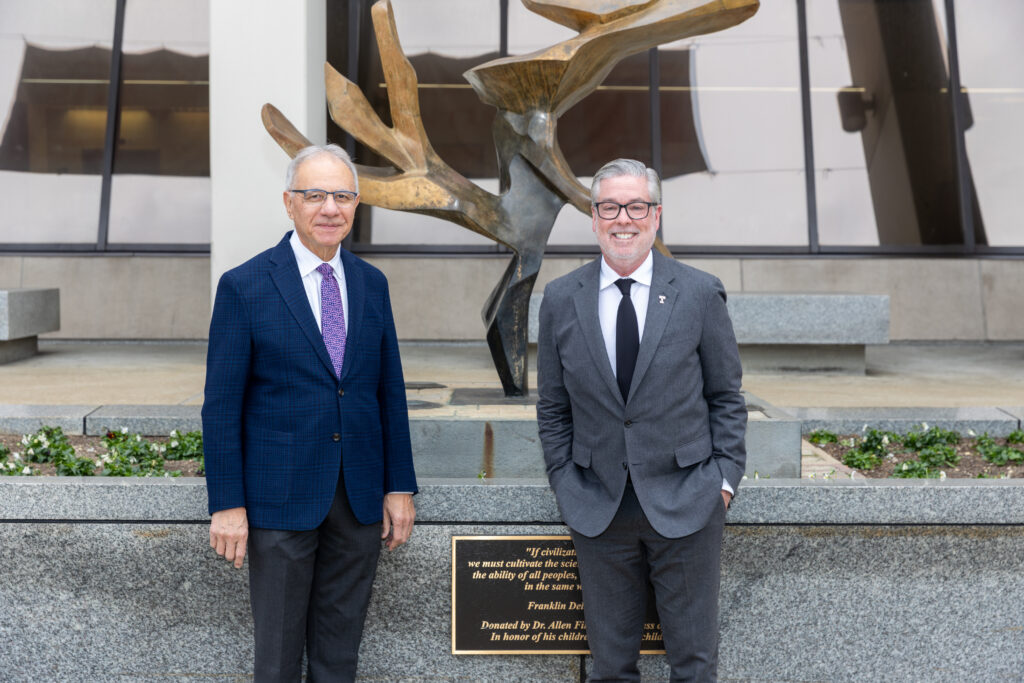
Dean Ismail and President in front of the
Temple Dental School’s Tree of Peace.
What might these programs mean to individual students?
These programs illustrate our intentional approach when it comes to providing a world-class education to students of all backgrounds. We talk about access a lot here at Temple, and programs like Temple Future Scholars and Temple Promise show that these are not just words. We know that Philadelphia is home to bright young minds, and we want to ensure these students have every opportunity to pursue higher education at Temple. Even before they step on to our campus, we’re saying to them: Temple believes in you, and we are invested in your success. Now, we would love all of the Temple Future Scholars to enroll at Temple, but even if they ultimately decide to enroll at another local university, that is still a great thing for this city and region.
What might these programs mean to the community? How will they help engage and serve the community, since I believe that is another focus for you?
Our students and graduates have a profound impact on their communities. They are your doctors, dentists, accountants, social workers, and perhaps most importantly, your friends and neighbors. Local students, the very ones impacted by these programs, embody Philadelphia’s grit and perseverance. And when they come to Temple, they bring that pride and sense of community with them, making our university stronger in the process. That is a big reason why we are so deeply committed to these programs. As I mentioned, a stronger Philadelphia means a stronger Temple, and we are excited to equip local students with the knowledge, training and resources that they can then use to make their communities, and our city, greater.
Temple and Temple Health are vital anchor institutions of the region, and it is important that we further amplify the work that we are doing to serve the Philadelphia community. We will be expanding our place-based work, and the Kornberg School of Dentistry will be an important participant in these efforts. The pediatric dental clinic that Kornberg operates at the William D. Kelley School in North Philadelphia is a powerful example of how Temple serves the community as the clinic provides essential, quality dental care to North Philadelphia children, regardless of insurance. It is another way that we have removed barriers to a better quality of life for our closest neighbors.
And we’re not done yet. Another dental clinic will be opening along Broad Street later this summer. These clinics serve as examples to the rest of the university of how Temple can and should be investing in the community.
What I do expect is that higher education will need to continue earning and rebuilding the public’s trust. That certainly includes providing a world-class education to our students and producing graduates who leave Temple ready to make an impact in their communities.
Please discuss why research and innovation are priorities for you. How do they benefit the local area and drive economic growth?
Particularly the life sciences and emerging technologies?
Advancing research and innovation is central to Temple’s mission as Philadelphia’s public research university. With our state-of-the-art facilities, urban location, world-class faculty, and visionary students with dreams of making an impact, we have all that is needed to spur innovation. There are also so many interdisciplinary research opportunities that exist here as we have outstanding professional schools in dentistry, medicine, pharmacy, podiatry, law, business and education, all housed under our institutional roof.
It is important that we use all these resources to facilitate discoveries that don’t just live in the lab, but that improve lives, solve real-world problems and strengthen our city.
Again, Kornberg has already bought in on this mission. Doctors Santiago Orrego and Carolina Montoya, with their groundbreaking dental gel that regenerates bone tissue, have turned their research into a practical solution. There now exists a noninvasive treatment alternative for adults with gum disease, thanks to these driven researchers and the support they received from our Office of the Vice President for Research.
Our research enterprise is also a powerful economic engine that generates jobs and drives investment in Philadelphia’s life sciences ecosystem. Emerging technologies, especially, have untapped potential. That’s why, with resources like our Innovation Nest, located in the Old Dental School building, we’ve placed an emphasis on incubating startups and spinout companies that are tenaciously pursuing novel applications for technologies like generative AI.
We are lucky to call Philadelphia home, and I believe it is our duty to figure out ways to leverage the potential of our city and its people. Discovery, research and innovation will play a big role in that.