
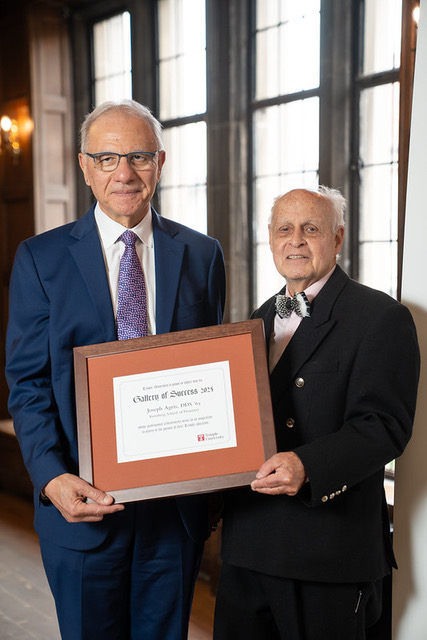
Honored with Temple University’s prestigious Gallery of Success Award on April 4th, Dr. Joe Agris, ’65, DDS, MD, FACS, was recognized for his decades of treating patients in areas that are desperate for basic medical care and reconstructive surgery. Along the way, he has provided critical instruction and education to hundreds of physicians and surgeons at medical institutions throughout the world.
AT TEMPLE DENTAL IN THE ‘60s, Dr Agris was good with his hands and liked surgery. However, he noticed that dentures would slide around. “I read about a fixed partial that was just coming out,” he says. “Even though we had to get it within a millimeter to fit, we made the appliance, and the school used it. I like that kind of stuff. You need to look for innovation to progress or modify to make something better.”
Dr. Agris worked his way through Rutgers University, then Temple Dental, graduating with honors, then Albany Medical College. After establishing the first plastic surgery program at the Federal Correctional Institution in Long Beach, California, he moved back to the Philadelphia area, practicing as a plastic, cosmetic, and reconstructive surgeon. Additionally, he has served as chief of surgery at the U.S. Public Health Service Commissioned Corps and is currently associated with Texas Medical Center in Houston, Texas.
Still dedicated to those who depend on his work, Dr. Agris and his team plan to go to the University of Lima in Peru for two weeks at the end of May.
“You learn to see what’s on the table and think how can I use it.”
Making people whole again
Outside of the Global South, dermatome is an electrical tool of choice for skin grafts. It can cut a thin, thick, or split-thick slice as fast as the eye can see, says Dr. Joe Agris. But in places like Pakistan and Nicaragua where cooking often leads to burns, the surgical device that can be so valuable in producing precise grafts is often unavailable.
So when Agris goes on his mission trips, he brings the machine with a supply of blades. And it’s not only dermatome that Agris brings. He collects all sorts of surgical equipment that’s outdated for U.S. hospitals and often trashed, but critical for providing care in developing countries. “They need the basics,” he says. “If I can take equipment apart to bring with me, I do it.”
He also brings people. Doctors pay their way plus half a ticket for a nurse or resident. Usually, 10 to 12 people go with him, although the number has reached 20. That includes a dedicated core group who “love it,” he says.
The residents work on two tables as Agris watches and supervises. What he’s observed is culture shock for state-side students. Adapting to the environment is a constant. “You learn to see what’s on the table and think how can I use it,” he emphasizes.
Innovation is a necessity
To illustrate, he remembers a man who had goats and made cheese. “When I saw him, his hands were like claws. He couldn’t milk the goats. He couldn’t continue his livelihood. He couldn’t support his family. And he needed a tourniquet to prevent blood loss during surgery.”
No fancy tourniquet with pressure dials was available, so Agris took stretchable elastic, cut two strips, and tied them together at the top. “Now I could squeeze out the blood,” he says. “You have to think out of the box. It’s part of the learning.”
His groups go on three to four trips a year and only stopped during Covid. But going back again and again to the same countries is important, he notes. The follow-up lets everyone know what to expect while Agris’s team learns the language, builds trust, and develops relationships. They also learn how to talk to a patient and show empathy, he says. In addition to being good medical practice, that can bring some surprising results.
Chickens and sandals
He recalls operating on a child with a cleft palate. Afterward, the father tried to come into the hospital with what he could offer in gratitude: two dead chickens for cooking. When staff kept him outside, Agris heard the commotion. “I go to see what’s wrong, and I’m handed the chickens. The father wants me to know: ‘This is for the doctor. I want to say thank you for what he did.’”
He describes another experience that still brings an appreciative smile. “A parent came with his child for treatment. He also brought a piece of paper. ‘Put your foot on it,’ he said. ‘Now put your other foot on it. I make sandals. I don’t have any money, but I’m going to make you a pair of sandals.’ He had a tracing, and about four days later he walked three or four miles into the hospital with the handsewn sandals made from cut rubber tires. They have tire treads. They don’t slip and will last me forever.”
Treating children and adults in developing countries for decades, Dr. Joe Agris has hundreds of stories to tell. Asked why he continues the mission trips, he says, “It’s the personal contacts with the families and kids. And what happens after the surgeries.”
In the cultures where he works with deformities, accidents, and burns, his patients’ lives are transformed. Many are no longer an outcast, unschooled and hidden, vulnerable to political radicalization. Others are able to resume a livelihood, supporting their families.
“It’s not just medical, it’s social,” he says. “Surgery is not a process itself. It makes people whole again.”