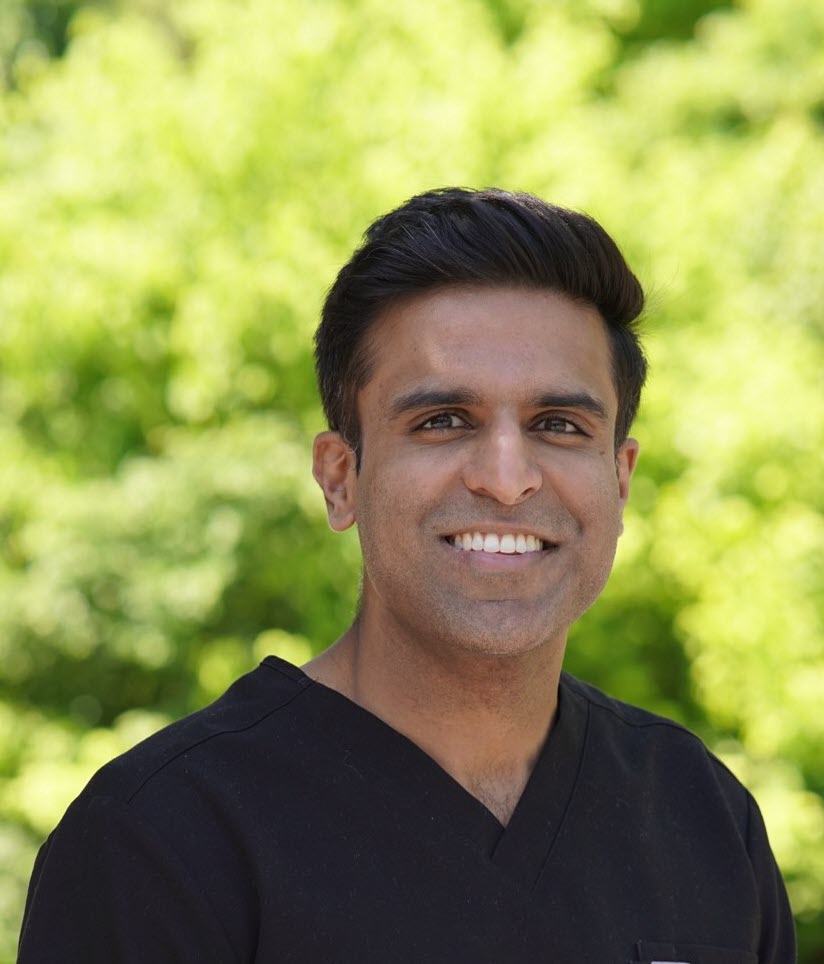
IN PAKISTAN WHERE Dr. Thobhani grew up, his grandmother always had trouble at meals. The situation wasn’t unusual in a country where healthcare, especially oral care, wasn’t the highest priority. Her issue was dentures, full ones, top and bottom.
Of course, she was fortunate that she could eat at all. But Dr. Raheel Thobhani remembers, “I couldn’t wrap my head around it—why it had to be that way. From a young age, I wanted to address it.”
That was the start of his interest in dentistry. And today, thanks to Temple Dental, he is helping patients the way he envisioned. But the route from there to here has not been a straight one. And thankfully so, maintains Thobhani.
Interrupting his path were four years in business while he consulted in technology and management. He was trying to figure out a career, perhaps even in medicine. Looking back, he realizes he was also building valuable skills.
“I got to see different management styles and learn different ways to communicate. Now I can apply that knowledge to how I talk with my staff, how I communicate with patients, and how we interact with vendors. You figure out what makes people tick, and you tailor your communication differently.”
Additionally, at a time when dentistry is rapidly changing, Thobhani learned how big corporations implement something new. As a result, when he decided to offer in-house membership programs in his private practice, he knew he needed a game plan with a way to test different scenarios—all before rolling out the final details. Still fine-tuning the program, Thobhani says his transferrable business skills continue to play a big role in his practice.
Real-world advice
Recalling his time at Temple Dental, Thobhani emphasizes that he made sure to build good relationships with instructors. “Beyond teaching us the basics of dentistry,” he explains, “they would talk with me about the real world outside of strictly clinical dentistry, such as how they would manage their practices.”
He adds: “Of all the instructors I ever spoke to, most of them currently owned or once owned their practices. I would pick their brains about different trends and everything they had seen over the years. I did it often, asking them what went well and what didn’t end up going so well, trying to learn a lot from real-world experiences that they all have. I still keep in touch with them, especially Dr. Richard Ram and Dr. Manly Mincer.”
With Temple Dental connections still in place, Thobhani values the knowledge and experience he can now tap into for help. Recently, he reached out to several of his instructors about a patient who takes biophosphonates for osteoporosis and needed an extraction. The risk, due to her medication, was painful osteoradionecrosis of the jaw.
“I wanted to hear other opinions and talk about a plan for this specific case,” he says. The dialogue helped. Thobhani avoided a full extraction though a choronectomy, cutting off part of the tooth and leaving a part that won’t have any effect on the patient.
Talking over difficult cases is one of the big reasons Thobhani likes to keep in touch. “As I’ve gotten further in my career,” he notes, “I’ve realized the benefits of collaboration. I don’t want to get stuck in my own bubble. I want to see how different people would plan various types of treatment. I think that’s going to make me a better clinician in general.”