

EARLY CHILDHOOD CARIES (ECC) is the most common chronic childhood disease and a significant public health problem, which can destroy teeth in young children and cause long-term, systemic health issues. Recent research links this potentially painful and costly dental disease with oral fungal infections in early life, namely oral thrush, which promotes the pathogenic biofilm formation on tooth surfaces. An NIH/NIDCR-funded longitudinal study led by Dr. Yuan Liu at Kornberg School of Dentistry is now further investigating this connection. Dr. Liu’s translational research team is following infants who have oral thrush and their counterparts who do not for two years. The hypothesis is that infants with oral fungal infection in their first year of life will present with higher risk of severe tooth decay.
Now entering its third year of the $839,700 grant, the study team collaborates with Temple Pediatric and recruits 69 infants. Dr. Liu’s research has three major components: First, evaluate the correlation between oral fungal infection and the onset/severity of ECC incorporating clinical factors. Second, longitudinally assess the microbial dynamics both compositionally and functionally using metagenomic sequencing. Third, comprehensively investigate bacterial-fungal interactions by ex vivo models, cutting-edge imaging technologies and artificial intelligence-aided prediction modeling. Through a better understanding of the fungal role in modulating microbial homeostasis and disease progression, Dr. Liu hopes to design practical applications for early diagnosing and preventing strategies for at-risk children.
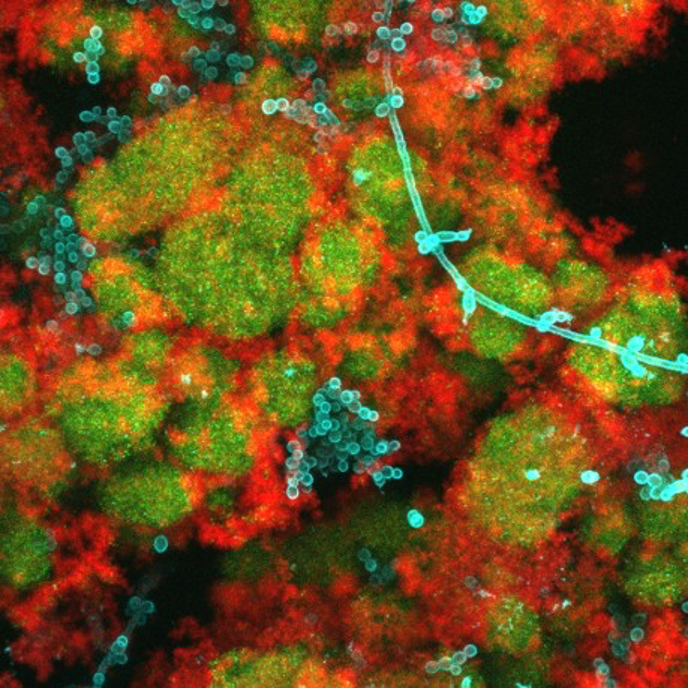
High-resolution confocal image showing bacterial-fungal cross-kingdom interactions enhancing biofilm formation and virulence (Green: bacteria-Streptococcus mutans; Cyan: fungi-Candida albicans; Red: extracellular polysaccharide)